Senin, 12 Oktober 2009


Naruto (NARUTO -ナルト-?, romanized as NARUTO) is an ongoing Japanese manga series written and illustrated by Masashi Kishimoto. The plot tells the story of Naruto Uzumaki, an adolescent ninja who constantly searches for recognition and aspires to become a Hokage, the ninja in his village that is acknowledged as the leader and the strongest of all. The series is based on a one-shot comic by Kishimoto that was published in the August 1997 issue of Akamaru Jump.

The manga was first published by Shueisha in 1999 in the 43rd issue of Japan's Weekly Shōnen Jump magazine. Currently, the manga is still being serialized with forty-seven tankōbon volumes released so far. The manga was later adapted into an anime, which was produced by Studio Pierrot and Aniplex. It premiered across Japan on the terrestrial TV Tokyo network and the anime satellite television network Animax on October 3, 2002. The first series lasted 220 episodes, while Naruto: Shippuden, a sequel to the original series, has been airing since February 15, 2007. In addition to the anime series, Studio Pierrot has developed six movies for the series and several original video animations (OVAs). Other types of merchandise include light novels, video games and trading cards developed by several companies.

Viz Media has licensed the manga and anime for North American production. Viz has been publishing the series in their Shonen Jump magazine, and as well as the indidividual volumes. The anime series began airing in the United States and Canada in 2005, and later in the United Kingdom and Australia in 2006 and 2007 respectively. The films, as well as most OVAs from the series, have also been released by Viz, with the first film premiering in cinemas. The first DVD volume of Naruto: Shippuden will be released by Viz in North America on September 29, 2009.

Serialized in Viz's Shonen Jump magazine, Naruto has become one of the company's best-selling manga series. As of volume 36, the manga has sold over 71 million copies in Japan. The English adaptation of the series has also appeared in the USA Today Booklist several times and volume 11 won the Quil Award in 2006. Reviewers from the series have praised the balance between fighting and comedy scenes, as well as the characters' personalities, but have criticized it for using standard shōnen plot elements.


PLOT

Naruto Uzumaki is a young boy who has the Nine-Tailed Demon Fox sealed within him. Twelve years before the start of the series, the Nine-Tailed Demon Fox attacked the ninja village Konohagakure, slaughtering many people. In response, the leader of Konohagakure and its ninja military – the Fourth Hokage – sacrificed his life to seal the demon inside Naruto when he was a newborn. Konohagakure, however, regarded Naruto as if he were the demon fox itself and mistreated him throughout most of his childhood. A decree made by the Third Hokage, who replaced the Fourth Hokage after his death, forbade anyone mention the attack of the demon fox to anyone. Years later, Naruto is tricked by the renegade ninja Mizuki into stealing a forbidden scroll, but is stopped by his teacher, Iruka Umino. When Iruka almost dies while protecting Naruto from Mizuki, Naruto defeats Mizuki using the power from the scroll, which develops the supernatural ability Jutsu Shadow Clone Technique that creates clones from himself. That encounter makes Naruto realize he was the container of the demon fox.


The Templars


The Poor Fellow-Soldiers of Christ and of the Temple of Solomon (Latin: Pauperes commilitones Christi Templique Solomonici), commonly known as the Knights Templar or the Order of the Temple (French: Ordre du Temple or Templiers), were among the most famous of the Western Christian military orders.[3] The organization existed for approximately two centuries in the Middle Ages.

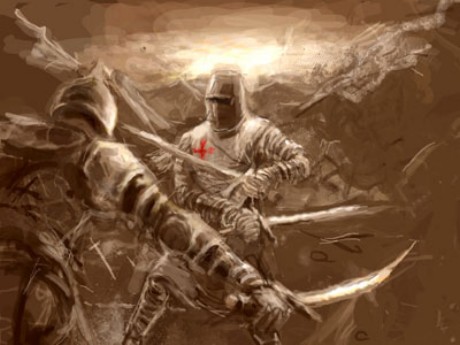
Officially endorsed by the Roman Catholic Church around 1129, the Order became a favored charity throughout Christendom, and grew rapidly in membership and power. Templar knights, in their distinctive white mantles with a red cross, were among the most skilled fighting units of the Crusades.[4] Non-combatant members of the Order managed a large economic infrastructure throughout Christendom, innovating financial techniques that were an early form of banking,[5][6] and building many fortifications across Europe and the Holy Land.

The Templars' existence was tied closely to the Crusades; when the Holy Land was lost, support for the Order faded. Rumors about the Templars' secret initiation ceremony created mistrust, and King Philip IV of France, deeply in debt to the Order, took advantage of the situation. In 1307, many of the Order's members in France were arrested, tortured into giving false confessions, and then burned at the stake.[7] Under pressure from King Philip, Pope Clement V disbanded the Order in 1312. The abrupt disappearance of a major part of the European infrastructure gave rise to speculation and legends, which have kept the "Templar" name alive into the modern day.


Modern Templar organizations

By papal decree, the property of the Templars was transferred to the Order of Hospitallers, which also absorbed many of the Templars' members. In effect, the dissolution of the Templars could be seen as the merger of the two rival orders.[59]

The story of the secretive yet powerful medieval Templars, especially their persecution and sudden dissolution, has been a tempting source for many other groups which have used alleged connections with the Templars as a way of enhancing their own image and mystery. [60] Since at least the 1700s the York Rite of Freemasonry has incorporated some Templar symbols and rituals,[4] and has a modern degree called "the Order of the Temple".

The Sovereign Military Order of the Temple of Jerusalem, founded in 1804, has achieved United Nations NGO status as a charitable organization.[61] There is no clear historical link between the Knights Templar, which were dismantled in the 14th century, and any of these other organizations, of which the earliest emerged in the 18th century. However, there is often public confusion and many overlook the 400-year gap.


Greenday

Green Day is an American rock trio formed in 1987.[1] The band has consisted of Billie Joe Armstrong (vocals, guitar), Mike Dirnt (bass guitar, vocals), and Tré Cool (drums, percussion) for the majority of its existence.

Green Day was originally part of the punk rock scene at 924 Gilman Street in Berkeley, California. Its early releases for independent record label Lookout! Records earned them a grassroots fanbase, some of whom felt alienated when the band signed to a major label.[2] Nevertheless, its major label debut Dookie (1994) became a breakout success and eventually sold over 10 million copies in the U.S. and 15 million worldwide.[3] As a result, Green Day was widely credited, alongside fellow California punk bands The Offspring and Rancid, with reviving mainstream interest in and popularizing punk rock in the United States.[4][5] Green Day's three follow-up albums, Insomniac, Nimrod and Warning did not achieve the massive success of Dookie, but they were still successful, reaching double platinum, double platinum, and gold status respectively.[6] Green Day's 2004 rock opera American Idiot reignited the band's popularity with a younger generation, selling five million copies in the U.S.[7] The band's eighth studio album, 21st Century Breakdown, was released on May 15, 2009.

Green Day has sold over 22 million records in the United States.[8] They have won three Grammy Awards; Best Alternative Album for Dookie, Best Rock Album for American Idiot, and Record of the Year for "Boulevard of Broken Dreams".

Band history

Formation and Lookout years: 1987–1993


In 1987, friends Billie Joe Armstrong and Mike Dirnt, 15 years old at the time, formed a band called Sweet Children. The first Sweet Children show took place on October 17, 1987, at Rod's Hickory Pit in Vallejo, California where Armstrong's mother was working.[1] In 1988, Armstrong and Dirnt began working with former Isocracy drummer, John Kiffmeyer (also known as Al Sobrante). Kiffmeyer served as both the band's drummer and business manager, handling the booking of shows and helping the band establish a fan base.[9]

Larry Livermore, owner of Lookout! Records, saw the band play an early show and signed them to his label. In 1989 they recorded their first EP, 1,000 Hours. Before 1,000 Hours was released, the band dropped the name Sweet Children, according to Livermore this was done in order to avoid confusion with another local band Sweet Baby.[10] The band adopted the name Green Day, allegedly due to their fondness of marijuana.[11]

Lookout! would release Green Day's first LP, 39/Smooth in early 1990. Green Day would record two EPs later that year: Slappy and Sweet Children, the latter of which included some older songs they had recorded for Minneapolis indie label Skene! Records. In 1991, Lookout! Records released 1,039/Smoothed Out Slappy Hours, a compilation of the 39/Smooth, Slappy, and 1,000 Hours EPs. In late 1990, shortly after the band's first nationwide tour, Sobrante left the East Bay area to attend college.[9] The Lookouts drummer Tré Cool began filling in as a temporary replacement, and when it became clear that Sobrante did not plan on committing to the band full time, Tré Cool's position as Green Day's drummer became permanent. The band went on tour for most of 1992 and 1993, and played a stretch of shows overseas in Europe. The band's second full length album Kerplunk sold about 50,000 copies in the U.S.


Sabtu, 10 Oktober 2009

Old Time F1 Racer

Michael Schumacher


(born 3 January 1969, in Hürth-Hermülheim, Germany[1]) is a German former Formula One driver and seven-time Formula One world drivers' champion, and current advisor for Ferrari. According to the official Formula One website, he is "statistically the greatest driver the sport has ever seen".[2] He is the only German to win the Formula One World championship,[3] and is credited with popularizing Formula One in Germany.[4] In a 2006 FIA survey, Michael Schumacher was voted the most popular driver of the season among Formula One fans.[5]
After winning two championships with Benetton, Michael Schumacher moved to Scuderia Ferrari in 1996 and won five consecutive drivers' titles with them from 2000–2004. Schumacher holds many records in Formula One, including most drivers' championships, race victories, fastest laps, pole positions, points scored and most races won in a single season. Schumacher is the only Formula One driver to have an entire season of podium finishes, a feat he accomplished in 2002. His driving sometimes created controversy: he was twice involved in collisions that determined the outcome of the world championship, most notably his disqualification from the 1997 championship for causing a collision with Jacques Villeneuve.[6] After the 2006 Formula One season Schumacher retired from race driving.[7]
Schumacher planned to return to F1 racing for the 2009 European Grand Prix as a replacement for injured Ferrari driver Felipe Massa.[8] However, it then became apparent that he was not fit enough to race due to a neck injury he sustained during a German Superbike test earlier in the year.[9]
Off the track, Schumacher is an ambassador for UNESCO and a spokesman for driver safety. He has been involved in numerous humanitarian efforts throughout his life and donated tens of millions of dollars to charity.[10] He is the elder brother of former F1 driver Ralf Schumacher, currently racing in Deutsche Tourenwagen Masters (DTM).[1] They stand as the only brothers in F1 history to have both won races and they scored the first sibling 1-2 finish in Formula One.


2009 - Planned comeback
In his capacity as racing advisor to Ferrari, Schumacher was present in Budapest for the 2009 Hungarian Grand Prix when Ferrari driver Felipe Massa was seriously injured after being struck by a suspension spring during qualifying. As it became clear that Massa would be unable to compete in the next race at Valencia, Schumacher was chosen as a replacement for the Brazilian driver.[81] Therefore, on 29 July 2009, Ferrari announced that they planned to draft in Schumacher for the 2009 European Grand Prix, and subsequent Grands Prix until Massa is able to race again.[8] He had already started to test in a modified F2007 to prepare himself.[82] He had been unable to test the 2009 car, due to testing restrictions. Ferrari appealed for special permission to test, but Williams, Red Bull and Toro Rosso were against this test.[83][84] However, Schumacher called off his return on August 10 due to the severity of his neck injury which he got in a motorcycle accident earlier in the year.[85] It is still unclear if Schumacher will race in 2009 after Valencia, or possibly in 2010, as Ferrari's president Luca di Montezemolo hinted Ferrari might push for a rule change which would allow Formula One teams to run three cars during a Grand Prix.

Batik Sebagai Budaya yang Mendunia

Batik mengacu pada dua hal. Yang pertama adalah teknik pewarnaan kain dengan menggunakan malam untuk mencegah pewarnaan sebagian dari kain. Dalam literatur internasional, teknik ini dikenal sebagai wax-resist dyeing. Pengertian kedua adalah kain atau busana yang dibuat dengan teknik tersebut, termasuk penggunaan motif-motif tertentu yang memiliki kekhasan. Batik Indonesia, sebagai keseluruhan teknik, teknologi, serta pengembangan motif dan budaya yang terkait, oleh UNESCO telah ditetapkan sebagai Warisan Kemanusiaan untuk Budaya Lisan dan Nonbendawi (Masterpieces of the Oral and Intangible Heritage of Humanity) sejak 2 Oktober, 2009.


Sejarah teknik batik


Seni pewarnaan kain dengan teknik pencegahan pewarnaan menggunakan malam adalah salah satu bentuk seni kuno. Penemuan di Mesir menunjukkan bahwa teknik ini telah dikenal semenjak abad ke-4 SM, dengan diketemukannya kain pembungkus mumi yang juga dilapisi malam untuk membentuk pola. Di Asia, teknik serupa batik juga diterapkan di Tiongkok semasa Dinasti T'ang (618-907) serta di India dan Jepang semasa Periode Nara (645-794). Di Afrika, teknik seperti batik dikenal oleh Suku Yoruba di Nigeria, serta Suku Soninke dan Wolof di Senegal.[2]. Di Indonesia, batik dipercaya sudah ada semenjak zaman Majapahit, dan menjadi sangat populer akhir abad XVIII atau awal abad XIX. Batik yang dihasilkan ialah semuanya batik tulis sampai awal abad XX dan batik cap baru dikenal setelah Perang Dunia I atau sekitar tahun 1920-an.[3]
Walaupun kata "batik" berasal dari bahasa Jawa, kehadiran batik di Jawa sendiri tidaklah tercatat. G.P. Rouffaer berpendapat bahwa tehnik batik ini kemungkinan diperkenalkan dari India atau Srilangka pada abad ke-6 atau ke-7. [2]Di sisi lain, J.L.A. Brandes (arkeolog Belanda) dan F.A. Sutjipto (arkeolog Indonesia) percaya bahwa tradisi batik adalah asli dari daerah seperti Toraja, Flores, Halmahera, dan Papua. Perlu dicatat bahwa wilayah tersebut bukanlah area yang dipengaruhi oleh Hinduisme tetapi diketahui memiliki tradisi kuna membuat batik.[4]
G.P. Rouffaer juga melaporkan bahwa pola gringsing sudah dikenal sejak abad ke-12 di Kediri, Jawa Timur. Dia menyimpulkan bahwa pola seperti ini hanya bisa dibentuk dengan mengunakan alat canting, sehingga ia berpendapat bahwa canting ditemukan di Jawa pada masa sekitar itu.[4]
Batik telah disebutkan dalam literatur Melayu abad ke-17, Sulalatus Salatin. Legenda ini menceritakan Laksamana Hang Nadim yang diperintah oleh Sultan Mahmud untuk berlayar ke India untuk mendapatkan 140 lembar kain serasah (diduga adalah batik) dengan pola 40 jenis bunga pada setiap lembarnya. Karena tidak mampu memenuhi perintah itu, dia membuat sendiri batik itu. Namun sayangnya kapalnya karam dalam perjalanan pulang dan hanya mampu membawa empat lembar batik sehingga membuat sang Sultan kecewa[5]
Dalam literatur Eropa, teknik batik ini pertama kali diceritakan dalam buku History of Java (London, 1817) tulisan Sir Thomas Stamford Raffles. Ia pernah menjadi Gubernur Inggris di Jawa semasa Napoleon menduduki Belanda. Pada 1873 seorang saudagar Belanda Van Rijekevorsel memberikan selembar batik yang diperolehnya saat berkunjung ke Indonesia ke Museum Etnik di Rotterdam dan pada awal abad ke-19 itulah batik mulai mencapai masa keemasannya. Sewaktu dipamerkan di Exposition Universelle di Paris pada tahun 1900, batik Indonesia memukau publik dan seniman.[2]
Semenjak industrialisasi dan globalisasi, yang memperkenalkan teknik otomatisasi, batik jenis baru muncul, dikenal sebagai batik cap dan batik cetak, sementara batik tradisional yang diproduksi dengan teknik tulisan tangan mengunakan canting dan malam disebut batik tulis. Pada saat yang sama imigran dari Indonesia ke Persekutuan Malaya juga membawa batik bersama mereka.


Budaya batik


Batik adalah kerajinan yang memiliki nilai seni tinggi dan telah menjadi bagian dari budaya Indonesia (khususnya Jawa) sejak lama. Perempuan-perempuan Jawa di masa lampau menjadikan keterampilan mereka dalam membatik sebagai mata pencaharian, sehingga di masa lalu pekerjaan membatik adalah pekerjaan eksklusif perempuan sampai ditemukannya "Batik Cap" yang memungkinkan masuknya laki-laki ke dalam bidang ini. Ada beberapa pengecualian bagi fenomena ini, yaitu batik pesisir yang memiliki garis maskulin seperti yang bisa dilihat pada corak "Mega Mendung", dimana di beberapa daerah pesisir pekerjaan membatik adalah lazim bagi kaum lelaki.
Tradisi membatik pada mulanya merupakan tradisi yang turun temurun, sehingga kadang kala suatu motif dapat dikenali berasal dari batik keluarga tertentu. Beberapa motif batik dapat menunjukkan status seseorang. Bahkan sampai saat ini, beberapa motif batik tadisional hanya dipakai oleh keluarga keraton Yogyakarta dan Surakarta.

Batik merupakan warisan nenek moyang Indonesia ( Jawa ) yang sampai saat ini masih ada. Batik juga pertama kali diperkenalkan kepada dunia oleh Presiden Soeharto, yang pada waktu itu memakai batik pada Konferensi PBB.

Story of Sky king


Air Gear ( Ea Gia) is a shōnen manga by the mangaka Ito "Oh Great" Ōgure. Air Gear is about the life of Itsuki Minami "Ikki", also known as "Baby face" and "Lil (and Little) Crow", and his friends. The story follows their use of Air Trecks, an in-universe invention derived from inline skates. The early parts of the story carry out the introduction of characters that eventually join Ikki. As the story progresses, it focuses on their roles as Storm Riders and their quest to be on the top of the Trophaeum Tower. It won the 2006 Kodansha Manga Award in the shōnen category.[1]


Story
Itsuki "Ikki" Minami, is a student and a delinquent. Also known as the "Unbeatable Babyface", Ikki is the leader of the youth gang by the name of "East Side Gunz". Upon his return home, after being humiliated by a Storm Rider team called the Skull Saders, Ikki discovers a secret hidden from him by his benefactors, the Noyamano sisters. The sisters belong to a group of Storm Riders who go by the team name of Sleeping Forest. In the anime, learning the sisters' secret angers him and he steals a pair of Air Trecks, abbreviated as "AT". (In the manga, the sisters give a pair of ATs to him and invite him to skate with them.) Ikki eventually settles his grudge with the Skull Saders, but in the process he receives more than the simple satisfaction of revenge. Determined to experience the sensation of "flight" for as long as he can, Ikki is quickly engaged in the mysterious, irresistible world of Air Treks.


Main characters


Itsuki "Ikki" Minami Voiced by: Kenta Kamakari (Japanese), Chris Patton (English)
The main protagonist of the story, he was given Air Trecks (in the anime, he took them himself) and soon delved into the world of Storm Riders. Eventually he creates a team, Kogarasumaru. Originally trained to become the Sky King by Sora, he soon finds himself betrayed by Sora and Nike, (Sora's twin brother) who steal his Regalia. Shortly thereafter, Ikki becomes the Storm King and follows the "Hurricane Road."
Kazuma "Kazu" Mikura Voiced by: Kenn (Japanese), Clint Bickham (English)
A long-time friend of Ikki, Kazu is a friend who's always by his side. He is a speed-type rider who has recently inherited the title of Flame King following the path of the flame road along with Spitfires old AT's. Due to his speed he got the nickname Stealth.
Onigiri Voiced by: Masami Kikuchi (Japanese), Greg Ayres (English)
Also a long-time friend of Ikki, Onigiri is a "perverted pig" as called by most. He has an unorthodox riding style, wearing his Air Trecks on his head and riding it upside-down. He has his own unique Road called the Smell Road, which uses an opponents senses against them.
Issa Mihotoke "Fats Buccha" Voiced by: Hitoshi Bifu (Japanese), Mark X. Laskowski (English)
Formerly of the Team Yaō (Night Kings), Buccha was defeated by Ikki and his team was forced to disband. Eventually, he joins Ikki's team as one of the main power riders, making use of his extremely large build and strength.
Akito/Agito/Lind Wanijima Voiced by: Kokoro Kikuchi (Japanese), Blake Shepard (English)
He is the Fang King with a split-personality. Akito is the "light" side while Agito is the "dark" side. They used to work for the police team of "WIND" until inspired by Ikki to leave and join Kogarasumaru after being rescued. Their split-personality changes depending on the side their eye patch is worn. Akito wears his patch on his right eye, Agito on his left. Later, a new personality named Lind emerged. Lind is somewhat like a "big brother" personality. He claims he is the original personality of the body.


Muse


Muse are a multi award-winning English alternative rock band that formed in Teignmouth, Devon in 1994. Since its inception, the band has comprised vocalist, guitarist and pianist Matthew Bellamy; bassist and backing vocalist Christopher Wolstenholme; and drummer Dominic Howard. Muse are known for their energetic and extravagant live performances [1][2][3][4] and their fusion of many music genres, including progressive rock, classical music and electronica.[5]
Muse have released five studio albums – Showbiz (1999); Origin of Symmetry (2001); Absolution (2003); Black Holes and Revelations (2006), which earned the band a Mercury Prize nomination and a third place finish in the NME Albums of the Year list for 2006;[6] and The Resistance (2009). Muse have won many other music awards throughout their career, including five MTV Europe Music Awards, five Q Awards, six NME Awards, two BRIT awards and four Kerrang! Awards. The majority of these awards have been attributed to their live performances.
Muse have been involved with Teenage Cancer Trust and have performed at the Royal Albert Hall where they donated all money made from the merchandise stands to the charity. On the 25th of September 2008 all three members of the band were awarded Honorary Doctorates of the Arts by Plymouth University.


Formation and early years (1992–1997)
The members of Muse played in separate bands during their stay at Teignmouth Community College and Coombeshead College in the early 1990s, but soon the formation of Muse began when Bellamy successfully auditioned for the part of guitarist in Dominic Howard's band. They asked Chris Wolstenholme, who played drums at the time, to learn to play bass guitar for the band. Wolstenholme agreed and took up lessons.
In 1994 the band used the name Rocket Baby Dolls with a goth/glam image to compete in a local battle of the bands. The band won the contest, smashing their equipment in the process.

"It was supposed to be a protest, a statement," Bellamy said, "so, when we actually won, it was a real shock. A massive shock. After that, we started taking ourselves seriously." Shortly after the contest, the three decided to forget university, quit their jobs, change the band name to Muse, and move away from Teignmouth.


[edit] Black Holes and Revelations and HAARP (2006–2008)
In July 2006, Muse released their fourth album, co-produced by Muse and by Rich Costey, titled Black Holes and Revelations. The album was released officially in Japan on 28 June 2006, in Europe on 3 July 2006 and, in North America on 11 July 2006. The album charted at No. 1 in the UK, much of Europe, and Australia. It was also a success in the United States, reaching number nine on the Billboard 200 album chart.[23] Black Holes and Revelations was nominated for the 2006 Mercury Music Prize, but lost to Arctic Monkeys. The album did, however, earn a Platinum Europe Award after selling one million copies in the continent.[24] The album's title and themes are the result of the band's fascination with science fiction and political outrage.[25][26] In August 2006, Muse recorded a live session at Abbey Road Studios for Live from Abbey Road.
The first single from the album, "Supermassive Black Hole", was released as a download on 9 May 2006 and accompanied by a music video directed by Floria Sigismondi. It was later followed by general releases as a single the next month, all ahead of the main album release. The second single, "Starlight", was released on 4 September 2006. "Knights of Cydonia" was released in the U. S. as a radio-only single on 13 June 2006 and in the UK on 27 November 2006. It also had a six-minute promotional video filmed in Romania and was featured on the popular video game Guitar Hero III: Legends of Rock. It was also voted number 1 in the world's largest music poll Australian Radio's Triple J Hottest 100 for 2007 and 18th in Triple J's Hottest 100 of All Time in 2009. The fourth single from the album, "Invincible", was then released on 9 April 2007.[27] Another single, "Map of the Problematique", was released for digital download only on 18 June 2007, following the band's performance at Wembley Stadium.


[edit] The Resistance (2009–present)
Main article: The Resistance (album)
The Resistance was released on 11 September in Italy, Germany and Australia and the Benelux, 14 September in the UK, and 15 September in the U.S. and Canada. It is the first Muse album to have been produced by the band themselves. The album was mixed by Mark Stent [43]
On its release, it topped the album charts in 19 countries and reached number 3 on the American album chart. It also beat its predecessor, Black Holes and Revelations, in relative album sales in its debut week in the UK with approximately 148,000 copies sold. [44] The first single "Uprising" was released 7 days earlier. [45]
On 2 June 2009, the band announced through e-mails and their website that they would begin a tour of Europe and the UK, beginning on 22 October 2009, at Hartwall Arena, Finland, and ending on 4 December, at Pala Olimpico, Turin, Italy, and including two nights at London's O2 Arena. A full list of tour dates can be found at their official website.[46] This tour had completely sold out their UK 95,000 allocated tickets within minutes from the general sale at 9 a.m. on 5 June.
On 14 July 2009, it was announced that the band will play their first televised United States performance at the MTV Video Music Awards on 13 September 2009, performing "Uprising".
The song "United States of Eurasia" is available for download along with Collateral Damage at the official Muse website.[The song was unlocked after a worldwide treasure hunt, 'Project Eurasia', consisting of USB keys with song data hidden in seven major cities: Paris, Berlin, Moscow, Dubai, Hong Kong, Tokyo, and New York. Each of the first six USB flash drives contained 1/6 of the song, which was uploaded to the Muse website once it was found. Until the last New York flash drive was found users could only listen to the song on the site, and were unable to download it. After the data from the New York flash drive was uploaded, the song was made available as a free download.
Zane Lowe played approximately 36 seconds of "Uprising" on 28 July 2009, ahead of its first full airplay on 3 August 2009 at 7:30 pm [BST]. This was the only clip made available to Radio 1 at the time. On 3 and 4 August, several radio stations aired "Uprising".
The band played live for the first time since recording, at two special homecoming gigs on a specially erected stage on the Den, a grassy area in Teignmouth, Devon, on 4 and 5 September 2009; dubbed 'A Seaside Rendezvous', where 30,000 more people turned up than bought tickets.
The East Coast of the U.S will get a big introduction to Muse when they open for U2 360° Tour 23 September to 14 October, 2009.[50] This portion of the tour will include New York City, Washington, D.C., Charlottesville (VA), Raleigh (NC), Atlanta, Tampa (FL), Dallas and Houston.
They have been confirmed as headliners for the Big Day Out Australian Music Festival. This will be part of their outdoor tour to take place throughout 2010. The band are also confirmed to play at the Stade de France, in Paris, the biggest French stadium, on 12 June 2010. There are many rumours of a proposed return to Wembley Stadium, where the band last played to 180,000 fans over two nights on 16 & 17 June 2007. There are also strong rumours that the band will play at the Reading Festival and Leeds Festival in England in August of 2010 after Melvin Benn, the organiser of both festivals disclosed to British newspaper The Daily Telegraph that Festival Republic were close to striking a deal with the band.
In the "Breakfast with Muse Concert" KROQ held, Muse was asked how long they would be on tour. They commented saying in a paraphrase, "We will probably be touring until the end of next year. We will be doing this U2 and European tour and ship off to Australia and Asia and return for an extensive US tour. It will actually be our longest US tour to date. Starting at about the end of February or March."



Blogger Templates by Isnaini Dot Com and Volkswagen Cars. Powered by Blogger